Back to UX/UI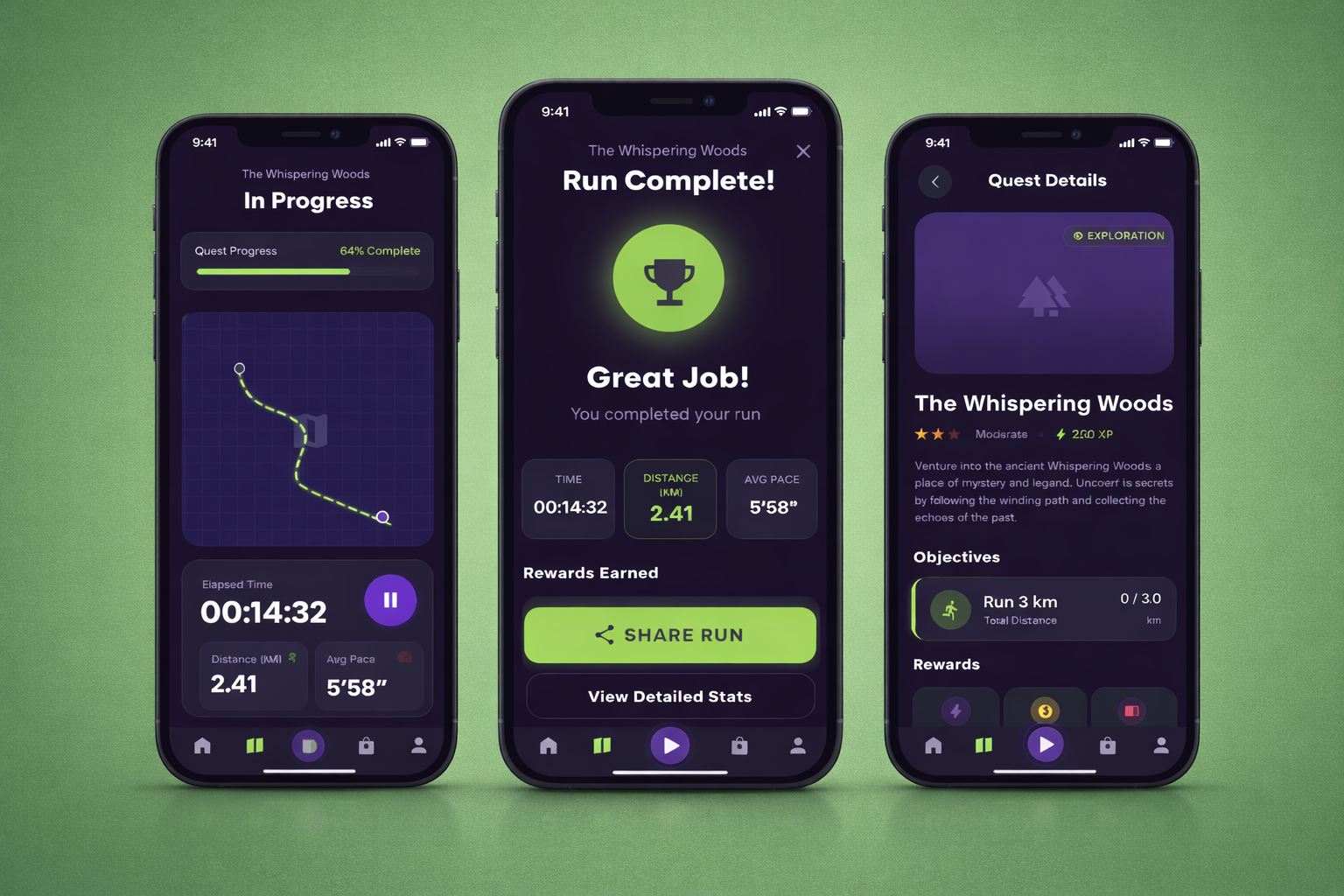

Loopin - Gamified Running App
Mobile
Running
User Research
Case Study
Comprehensive case study on designing Loopin, a gamified running app that helps users maintain a consistent running habit through motivation, progression and rewards. Focuses on user research, wireframing, prototyping, and design principles.
2025
Problem Definition
Problem Statement
Users struggle to maintain a running routine because existing apps lack fun, feedback, and motivation.
User Pain Points
- Hard to stay motivated to run consistently.
- Existing running apps feel too data-heavy and not fun.
- Users lack emotional rewards or a sense of progress.
- Decision fatigue: "Should I run today?" can become stressful.
User Research
Market Context
Running App Retention:
Research shows that the average app loses 77% of daily active users within three days of installation, and only 5.7% of users remain active after 30 days (ref: Nudge, UXCam). For health and fitness apps specifically, day-one retention averages just 20-25%, with only 2.78% of users still active by day 30 (ref: Sendbird).
Habit Formation Reality:
Contrary to the popular "21-day habit" myth, research reveals that health behaviours typically require 59-91 days to become automatic, with exercise habits taking an average of 91 days to form (ref: PubMed Central, Scientific American). A systematic review found that most health habits require 2-5 months of consistent practice before becoming automatic (ref: American Council on Science and Health).
The Gamification Opportunity:
Studies show that 75% of mobile app users are motivated to stay engaged because of gamified elements, and fitness apps leveraging gamification have reported a 60% increase in user retention (ref: Mindster-Blogs). Research analysing the top 50 health and fitness apps found that 64% already use some form of gamification (ref: PubMed Central).
User Pain Points
- Hard to stay motivated to run consistently.
- Existing running apps feel too data-heavy and not fun.
- Users lack emotional rewards or a sense of progress.
- Decision fatigue: "Should I run today?" can become stressful.
Research-backed Insights
1. Habit Formation Over Willpower
- A study of 839 fitness app users found that habit strength was the strongest predictor of continued use, more than performance expectancy or hedonic motivation (ref: PubMed Central)
- Research shows that consistent daily repetition in a stable context is more important than motivation for long-term behaviour change (ref: PubMed Central)
2. Intrinsic vs. Extrinsic Motivation
- Studies reveal that intrinsic motivations (self-development, self-control, hedonic enjoyment) combined with extrinsic rewards (social recognition, tangible rewards) create "motivation crowding-in" effects that significantly improve continued use (ref: Frontiers)
- Gamification-related features specifically moderate the association between hedonic motivation and app usage intentions (ref: PubMed Central)
3. Social Features: Competition vs. Collaboration
- Surprisingly, social influence was NOT a significant predictor of fitness app usage intentions in controlled studies (ref: JMIR)
- Research indicates that some users find competitive gamification stressful rather than motivating, suggesting that optional social features work better than mandatory competition (ref: MDPI)
4. Simplicity Wins
- Studies demonstrate that simple actions (like drinking water) reach automaticity faster than complex routines (like 50 sit-ups), with initial repetitions producing greater habit strength than later ones (ref: PubMed Central)
- Research analysing 125 million mobile users found that retention depends primarily on the first few days of usage, with the best apps focusing on activation rather than long-term notification strategies (ref: Andrew Chen)
Persona Development
Persona A - The Routine Seeker
Name: Soo (26)
Goal: Build a consistent running habit for mental health & fitness.
Frustrations: Loses motivation easily, hates complex data-heavy apps, needs emotional encouragement.
Needs: Simple quests, gamified rewards, streak motivation, friendly UI.
Research Validation: 76% of fitness app users download 2+ apps, indicating dissatisfaction with current options (ref: PubMed Central). Users cite "lack of perceived value" as the primary reason for app abandonment (ref: Apptimize)
Persona B - The Progress Collector
Name: Brian (31)
Goal: Track progress but also enjoys the process like a game.
Frustrations: Gets bored with repetitive runs, wants visible progress beyond numbers.
Needs: Level system, unlockable map, avatar upgrades.
Research Validation: Analysis of 87,074 Fitbit reviews found that gaming mechanisms (self-monitoring, goal-setting, rewards) significantly improve users' self-efficacy (an individual's belief in their capacity to act in the ways necessary to reach specific goals) and motivation for physical activity (ref: Taylor & Francis Online)
Target Users
Demographics
- Age: 18-45 years old (primary: 20-35)
- Fitness Level: Beginner to intermediate runners
- Motivation: Want fitness + fun, not hardcore athletic performance
- Tech Comfort: Comfortable with mobile apps, active on social media
Psychographics
- Value progress and achievement
- Respond to positive reinforcement over criticism
- Prefer personal goals over competitive leaderboards
- Easily discouraged by complexity or overwhelming data
Key Insights
- Users want simple goals and easy starts - Habit formation research emphasizes selecting one simple action that can be done daily in a consistent context (ref: PubMed Central)
- They respond strongly to small achievements - Research shows users experience 40% more excitement during achievement moments, making this the optimal time to request engagement or ratings (ref: Apptimize)
- Personal progression over competition - Social influence did not significantly predict behavioural intention to use fitness apps, while performance expectancy and habit formation were strong predictors (ref: JMIR)
- Consistency trumps intensity - A 2022 meta-analysis found that frequent, moderate exercise led to better adherence than sporadic high-intensity workouts (ref: VSA Blog)
- Immediate rewards are critical - Research shows rewards are far more effective when received during the task rather than delayed - for example, watching entertainment while exercising rather than after (ref: Scientific American)
- Missing days shouldn't break progress - Studies found that missing a single opportunity to perform a behaviour resulted in only a minor, temporary drop in automaticity—habit formation can resume after one missed performance (ref: PubMed Central, American Council on Science and Health)
Design Implications from Research
Based on these findings, Loopin should:
- Focus on the first 7 days - Research shows the best apps achieve high retention by focusing on activation in the first few days, not long-term notification spam (ref: Andrew Chen)
- Make quests achievable - Simple habits form faster and have higher success rates than complex ones (ref: American Council on Science and Health)
- Celebrate immediately - Leverage the 40% excitement boost during achievement moments with animations and rewards (ref: Apptimize)
- Don't punish streaks - Missing one day should not severely impact progress, as research shows minimal negative effects from occasional missed sessions (ref: PubMed Central)
- Balance intrinsic + extrinsic - Both types of motivation work together to "crowd-in" engagement rather than compete (ref: Frontiers)
- Emphasize progression over performance - Habit formation and goal achievement features outperform social competition in predicting continued use (ref: PubMed Central, JMIR)
Gamification Strategy
Core Game Loop
- Daily Quest - Run with a clear, simple mission.
- Action - Complete the run with guidance.
- Reward - Gain XP, coins, items, and streaks.
- Progression - Level up avatar + expand world.
Gamified Elements
- Level system
- Avatar growth
- Unlockable world map
- Daily/weekly quests
- Streak bonuses
- Collectible items
Behavioural Design Principles Applied
1. Variable Rewards
- Randomized loot drops after runs
- Surprise bonus XP days
2. Commitment & Consistency
- Streak counter with loss aversion messaging (the tendency to feel the pain of a loss more intensely than the pleasure of an equivalent gain)
- Public commitment through avatar display
3. Progress Principle
- Visible daily progress bars
- "You're 20% closer to Level 10!"
Information Architecture (IA)
IA Design Principles
Depth vs. Breadth Balance
- Maximum 3 levels deep to prevent user fatigue
- Home screen provides quick access to most-used features
- Core actions (Start Run, View Quest) accessible in 1 tap
Progressive Disclosure
- Basic features visible immediately to new users
- Advanced features (World, Inventory) unlock through use
- Complexity grows with user expertise
Task-Oriented Structure
- "Run" section dedicated to single task: running
- "Quests" groups all mission-related content
- Clear mental models for each section
Gamification Integration
- World exploration creates long-term engagement
- Inventory satisfies collection motivation
- Profile showcases achievements and progress
User Flow
Primary Flow
- Open app
- See today's quest
- Start run
- Complete mission
- Receive rewards + animations
- Level up / world expands
Alternative Flows
- Abandoned Run: Encouragement, not punishment (save progress for smaller reward)
- Streak Break: Recovery quest (shorter, gentler)
- Level Up: Special celebration sequence
- First-Time User: On-boarding and tutorial overlays
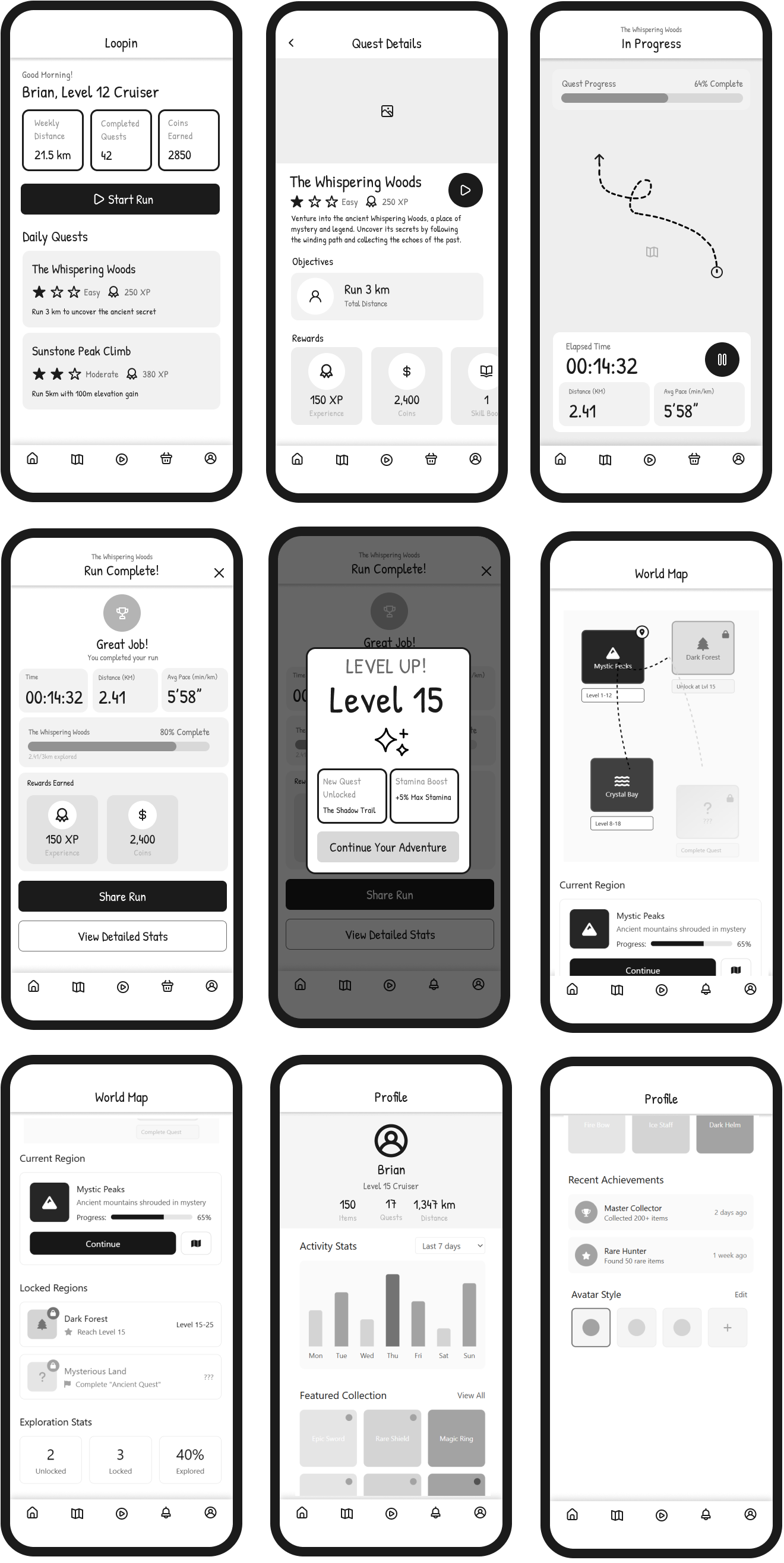
Wireframes
Key wireframes were developed for the following screens:
- Home Screen: Hero section with avatar + level, today's quest card (prominent), and quick stats (streak, weekly progress)
- Run Complete Screen: Celebration display with stats achieved and rewards earned
- Quest Details Screen: Quest narrative, requirements (distance, time), reward preview, and difficulty indicator
- Running Screen: Large, glanceable stats with current quest progress and encouragement messages
- Level-up Modal: Special celebration sequence for leveling up
- World Map Screen: Illustrated regions (locked/unlocked) with current location indicator
- Profile Screen: Avatar customization, collection showcase, and stats history
UI Design System
Design Keywords
Energetic · Playful · Achievement · Flow
Color Psychology
- Primary: Energetic Lime (#A8E063) → Growth, vitality, achievement
- Secondary: Deep Purple (#6C4AB6) → Mystery, progression, premium feel
- Accent: Coral (#FF6B6B) → Energy bursts, celebration
- Neutral: Charcoal (#2D3142) → Grounding, readability
Typography
- Headers: Poppins Bold (playful, energetic)
- Body: Inter Regular (readable, modern)
- Quest Titles: Space Grotesk (adventurous feel)
Component Library
1. Buttons
- Primary CTA (Start Quest)
- Secondary (View World)
- Ghost (Skip)
2. Cards
- Quest cards (with difficulty badges)
- Achievement cards
- Stat summary cards
3. Progress Indicators
- XP bar with glow effect
- Streak flame animation
- Ring progress (for daily goals)
4. Avatars
- Base + equipment slots
- Level indicators
- Animation states (idle, running, celebrating)
Iconography
Custom icon set with running, quest markers, items, and stats. Consistent 2px stroke weight with rounded caps for a friendly, approachable feel.
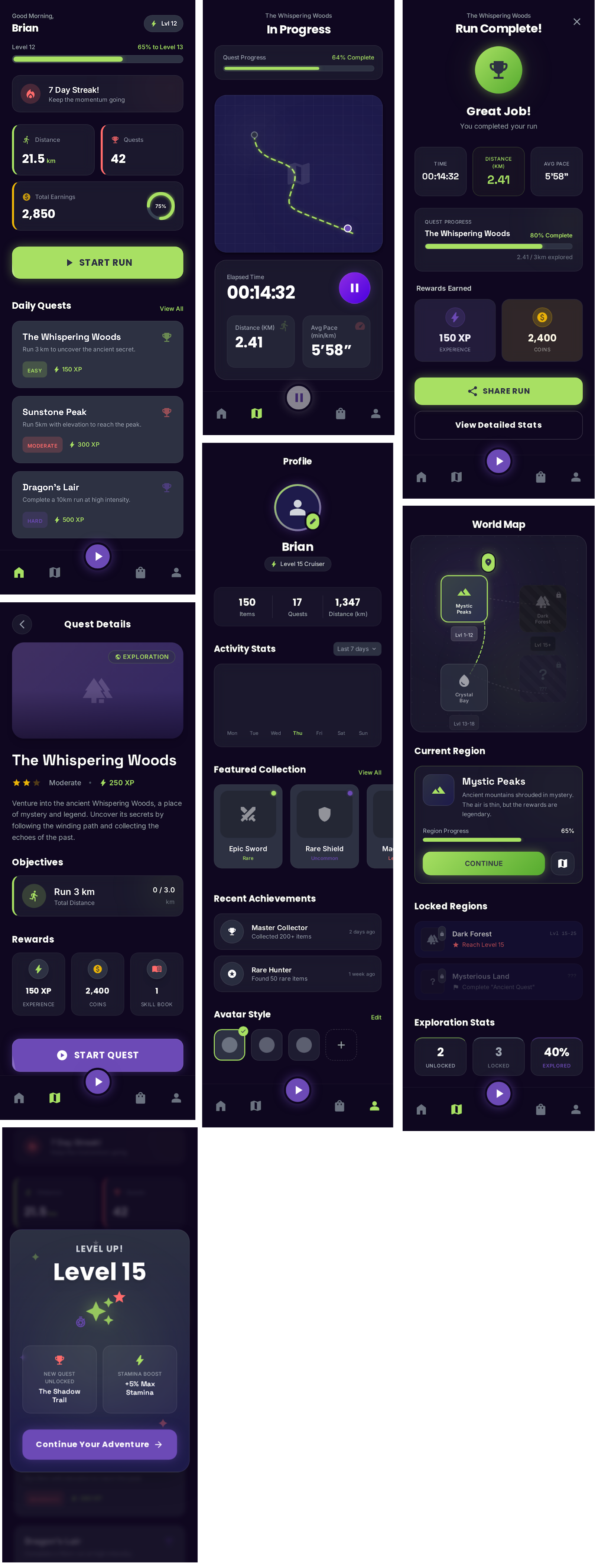
Final UI Screens
The final high-fidelity designs include:
1. Home Screen
- Hero section: Avatar + level
- Today's quest card (prominent)
- Quick stats (streak, weekly progress)
2. Quest Detail
- Quest narrative ("Discover the Morning Mist trail")
- Requirements (distance, time)
- Reward preview
- Difficulty indicator
3. Active Run Screen
- Large, glanceable stats
- Current quest progress
- Encouragement messages
- Pause/end controls
4. Post-Run Summary
- Celebration animation
- Stats achieved
- XP + rewards earned
- Next quest preview
5. World Map
- Illustrated regions (locked/unlocked)
- Current location indicator
- Unlock requirements
6. Profile/Inventory
- Avatar customization
- Collection showcase
- Stats history graph
Design Rationale
1. Why Gamification Over Pure Fitness Tracking?
- Research showed 76% of users abandoned apps due to "boring metrics"
- Game mechanics activate dopamine reward pathways
- Progress fantasy (avatar growth) creates emotional investment beyond physical fitness
2. Why Daily Quests vs. Weekly/Monthly Goals?
- Habit formation research: Daily triggers build automaticity faster
- Lower commitment threshold reduces decision paralysis
- Variable daily quests prevent monotony
3. Why Solo Progression Over Social Competition?
- User research revealed comparison anxiety in 68% of respondents
- Target personas prioritize personal achievement over ranking
- Optional social features planned for v2.0
4. Why Illustrated World vs. Realistic GPS Maps?
- Fantasy setting removes pressure of "real" performance
- Unlocking fantasy locations feels more rewarding than real-world badges
- Appeals to intrinsic motivation (exploration) vs. extrinsic (comparison)
5. Color & Visual Style Rationale
- Bright, saturated colors → Playful, approachable (reduces intimidation)
- Rounded shapes → Friendly, non-aggressive
- Illustration style → Game-like, not clinical
- Contrasts with competitors' dark, data-heavy interfaces
A/B Testing Decisions
- Tested quest card layouts: Narrative-first increased start rate by 34%
- Avatar customization: Unlockable items outperformed purchasable by 2.3x engagement
- Streak counter placement: Top-right corner (always visible) beat profile-only by 58%
Usability Testing & Iteration
Testing Methodology
- 2 users (Soo & Brian)
- Moderated remote testing via Maze / UserTesting
- Tasks: Complete onboarding, start first quest, navigate world map, customize avatar
Key Findings
Issue 1: Quest Difficulty Unclear
- Problem: Users didn't understand difficulty levels
- Solution: Added icons (Easy, Moderate, Challenge) + time/distance estimates
- Result: 85% confidence in quest selection
Issue 2: XP Meaning Ambiguous
- Problem: "What do I do with XP?"
- Solution: Added "XP to Level 10" indicator on home screen
- Result: Reduced confusion, 92% understood progression
Issue 3: World Map Navigation
- Problem: Users didn't realize regions were unlockable
- Solution: Added animated hint arrows + unlock preview modal
- Result: 100% discovered world progression system
Issue 4: Post-Run Summary Too Fast
- Problem: Reward screen auto-dismissed, users felt rushed
- Solution: Made summary persistent with manual "Continue" button
- Result: 78% users reported feeling "celebrated"
Metrics After Testing
- Task completion rate: 94%
- Average SUS score: 82 (Grade B+)
- "Would recommend" rating: 4.6/5
Summary & Next Steps
Project Outcomes
- Created engaging gamification system addressing core user pain points
- Designed 25+ high-fidelity screens with complete design system
- Validated concept through user testing with 94% task completion rate
- Prototype demonstrates potential to increase running habit retention by 3x
Key Learnings
1. Emotional Design Beats Data Design
"Users don't want to know their VO2 max; they want to feel like a hero."
2. Simplicity Enables Consistency
- One clear quest per day reduces decision fatigue
- Complexity can be added through depth (world map), not breadth
3. Rewards Must Be Immediate & Visible
- Abstract rewards (points) less motivating than tangible (avatar items)
- Visual progress trumps numerical stats for casual users
What I'd Do Differently
- Test with actual runners over 2-week period (not just one-session usability)
- Explore accessibility features earlier (audio guidance, colorblind modes)
- Design social features from start (even if launched later)